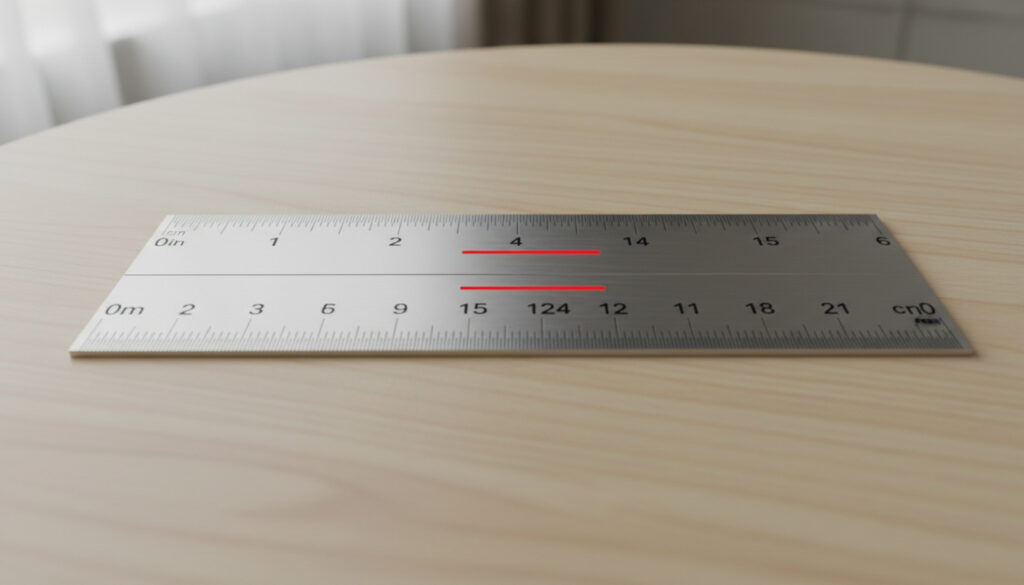
6 Inch in CM – Exact Conversion to 15.24 Centimeters
Six inches translates to exactly 15.24 centimeters under the international standard established in 1959. This conversion applies universally across science, engineering, and commerce, regardless of whether you measure a display diagonal or a physical object.
The relationship between imperial and metric units often creates confusion for international travelers and online shoppers. Precision matters significantly when converting six-inch measurements for manufacturing specifications, medical devices, or architectural plans.
How Many Centimeters Are in 6 Inches?
The direct answer is 15.24 centimeters. This figure represents an exact conversion rather than an approximation, based on the international agreement that defines one inch as precisely 2.54 centimeters. Roboconverter confirms this calculation yields 15.24 cm without rounding.
Key facts about this conversion:
- The international inch was defined as exactly 25.4 millimeters in 1959
- NIST recognizes the conversion as mathematically exact with no precision loss
- Common conversation often rounds to 15 cm, creating a 0.24 cm error
- Engineering tolerances require the full 15.24 cm specification
- Fractional representation equals 15 6/25 centimeters
- Reverse conversion requires multiplying by 0.39370079
| Imperial | Metric |
|---|---|
| 6 inches | 15.24 cm |
| 1 inch | 2.54 cm |
| 12 inches (1 foot) | 30.48 cm |
| 2 inches | 5.08 cm |
| 3 inches | 7.62 cm |
| 4 inches | 10.16 cm |
| 5 inches | 12.70 cm |
| 7 inches | 17.78 cm |
Is 6 Inches Exactly 15 Centimeters?
No. Six inches equals 15.24 centimeters, not precisely 15 centimeters. The 0.24-centimeter difference matters significantly in technical applications. CalculateMe lists the precise value as 15.24, while acknowledging that casual contexts sometimes accept 15 cm as a rounded approximation.
The Two-Millimeter Difference
The variance between 15 cm and 15.24 cm measures 2.4 millimeters. In woodworking or machining, this gap exceeds standard tolerances. Medical imaging and pharmaceutical dosing also demand the precise 15.24 cm calculation rather than the rounded figure.
Manufacturing specifications require maintaining full decimal precision (15.24 cm) until final calculations to prevent cumulative rounding errors in multi-step processes.
Fractional Representations
Some technical manuals express 6 inches as 15 6/25 centimeters. Worldometers notes an alternative fractional form of 15 15/64 cm, which differs by approximately 0.06 millimeters from the exact decimal value.
How Do You Convert 6 Inches to Centimeters?
Multiply the inch value by 2.54. For six inches: 6 × 2.54 = 15.24 cm. This formula works because the National Institute of Standards and Technology defines the inch as exactly 2.54 centimeters following the 1959 international agreement.
Federal Register Notice 59-5442, published June 30, 1959, formally established that the standard inch equals exactly 25.4 millimeters. This metric redefinition unified measurement standards across countries, with the American yard shortened and the imperial yard lengthened to align with metric measures.
Manual Calculation Method
Write down 6.0 as your starting value. Multiply by 2.54, carrying decimal places through each step. The result shows 15.24. Verify by checking that your answer falls between 15 and 16 centimeters, since six inches represents half a foot.
Digital Conversion Tools
Online calculators eliminate arithmetic errors. They apply the same 2.54 factor but display results instantly. Some tools also provide the inverse conversion, showing that 15.24 cm equals 6 inches when multiplied by 0.39370079.
When Did the Inch Become Exactly 2.54 Centimeters?
The exact definition took effect in 1959. Prior agreements varied slightly between nations, causing discrepancies in precision engineering and international trade.
- : International agreement among English-speaking nations redefines the inch as exactly 25.4 millimeters (2.54 cm)
- : Federal Register Notice 59-5442 publishes the formal definition in the United States
- : United Kingdom and Canada align their standards with the US definition
- : NIST Handbook 44 (2024) continues to recognize this as an exact conversion factor
Exact Measurement or Approximation: Which Applies?
Established Facts
- 6 inches = 15.24 cm exactly
- 1 inch defined as 2.54 cm since 1959
- NIST recognizes zero precision loss in conversion
- Legally binding in international trade
Common Variations
- 15 cm (rounded to integer)
- 15.2 cm (one decimal place)
- 15 15/64 cm (fractional approximation)
- Context-dependent precision requirements
Where Are 6-Inch Measurements Commonly Used?
Six-inch dimensions appear across consumer electronics, food service, and construction materials. Screen manufacturers quote diagonal measurements in inches, while European medical guidelines often require centimeter equivalents. Understanding both units prevents confusion when comparing Cost of Living Payment Amounts against device specifications or architectural plans.
Smartphone displays, tablet screens, and small monitor dimensions frequently reference six inches. Pizza diameters and cake pans also use this measurement. International retailers must display metric equivalents to comply with EU and UK labeling regulations.
Who Defines the International Inch Standard?
The National Institute of Standards and Technology maintains the official US standard. The 1959 agreement unified previously divergent British and American inch definitions. This standardization eliminated previous variations of approximately 0.0002 inches that existed between national standards.
The standard inch is exactly equivalent to 25.4 millimeters, established through international agreement to unify measurement standards across countries.
Federal Register Notice 59-5442, June 30, 1959
What Is the Final Conversion for 6 Inches?
Six inches equals exactly 15.24 centimeters. This value derives from the internationally recognized definition of one inch as 2.54 centimeters, established in 1959 and maintained by national standards bodies including NIST. While casual conversation may accept 15 cm, technical applications require the precise 15.24 cm figure. For additional context on standards affecting commerce and regulation, see HMRC Income Tax Changes.
Frequently Asked Questions
Why is an inch defined as exactly 2.54 centimeters?
The 1959 international agreement among English-speaking nations established this exact definition to unify previously divergent standards. It converts precisely to 25.4 millimeters, eliminating measurement discrepancies in international trade and engineering.
Can I safely round 6 inches to 15 centimeters?
For casual estimation, yes. However, engineering, medical, and manufacturing contexts require the exact 15.24 cm to prevent tolerance errors. The 0.24 cm difference equals 2.4 millimeters.
What is 6 inches in millimeters?
Six inches equals 152.4 millimeters. Multiply 15.24 centimeters by 10, or multiply 6 inches by 25.4 millimeters per inch.
How does a 6-inch screen compare to A4 paper?
A 6-inch screen measures 15.24 cm diagonally. A4 paper is 21.0 cm × 29.7 cm, making the screen significantly smaller than the paper’s width.
Is the 2.54 cm conversion factor universal?
Yes. The International System of Units (SI) recognizes this exact conversion. The National Institute of Standards and Technology confirms no precision loss occurs when converting between these units.
More related posts
 Cast of Outlander Blood of My Blood – Complete Cast Guide
 How Many Grams of Protein in an Egg – By Size, White and Yolk
 Day of the Jackal Season 2 – Release Date, Cast, and Everything We Know
 How To Cure Rheumatoid Arthritis Permanently – Expert Guide
 UK Online Safety Act – Summary, Encryption & Child Safety
 Kate Abdo – Everything About Her Husband Career and Net Worth
 Kourtney Kardashian – Age, Husband, Kids, Net Worth and Bio 2025
 The Rock Net Worth – $800M 2025 Complete Breakdown
