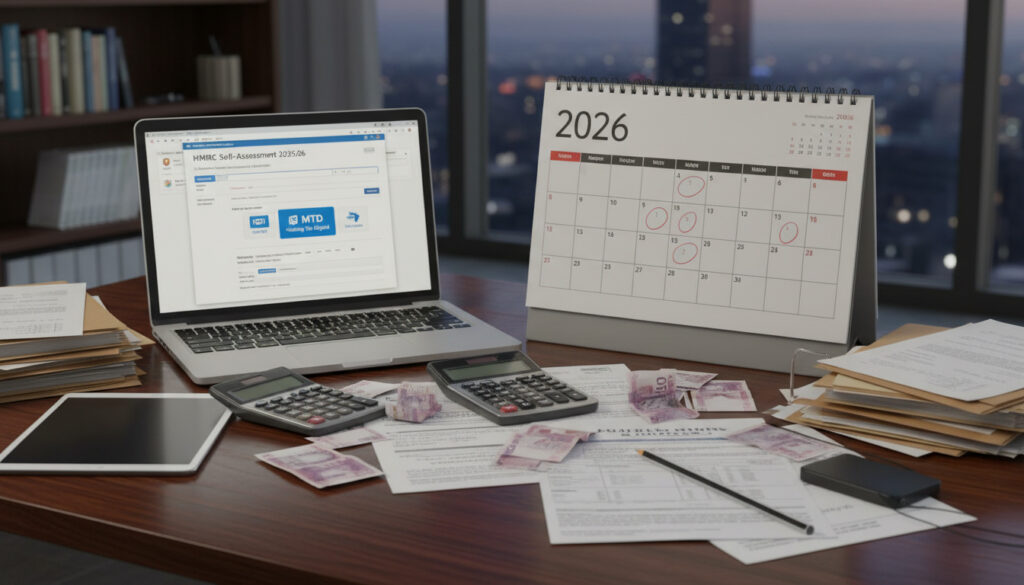
HMRC MTD Income Tax Changes 2026 – What You Need to Know
HMRC is fundamentally changing how millions of sole traders and landlords report their taxes. From April 2026, Making Tax Digital for Income Tax Self Assessment (MTD for ITSA) will replace the traditional annual tax return with a system of quarterly digital updates and year-end declarations.
The reforms mandate digital record-keeping and require compatible software for all submissions. Eligibility hinges on qualifying income thresholds, with the first wave affecting those earning above £50,000 from self-employment or property ventures. HMRC guidance confirms the changes apply to UK and overseas property income.
HMRC will notify affected taxpayers by letter after reviewing 2024-2025 returns. Those required to join must submit updates every three months through approved digital channels or risk penalties.
What is Making Tax Digital for Income Tax Self Assessment?
MTD for ITSA represents the extension of HMRC’s digital tax strategy to income tax payers. The system requires continuous digital record-keeping and regular submission of financial data throughout the tax year, fundamentally altering the annual cycle that self-employed individuals have followed for decades.
6 April 2026 (Phase 1)
£50,000 qualifying income
Quarterly updates plus year-end statement
HMRC-compatible digital tools only
Key Insights
- Phased rollout begins April 2026, completing with the £20,000 threshold in April 2028
- Annual Self Assessment returns will be abolished for those within MTD scope
- Digital records must be maintained continuously throughout the tax year
- Four quarterly submissions required per tax year with fixed deadlines
- End of Period Statement (EOPS) required to finalise business income calculations
- HMRC will issue advance notification letters to eligible taxpayers from April 2025
- Only HMRC-recognised software permitted for submissions
Essential Facts
| Aspect | Detail | Effective Date |
|---|---|---|
| Phase 1 Threshold | Over £50,000 qualifying income | 6 April 2026 |
| Phase 2 Threshold | Over £30,000 qualifying income | 6 April 2027 |
| Phase 3 Threshold | Over £20,000 qualifying income | 6 April 2028 |
| First Quarterly Deadline | 7 August 2026 | 2026-27 tax year |
| Last Traditional SA | 31 January 2027 | For 2025-26 tax year |
| Record Format | Digital only | From compliance date |
| Submission Method | HMRC-compatible software | No manual alternatives |
| Assessment Basis | 2024-25 tax year return | Determined January 2026 |
| Notification Method | Letter from HMRC | From April 2025 |
| Applicable Entities | Sole traders, landlords, partnerships | Per qualifying income |
When does MTD for income tax start and who is affected?
The rollout follows a three-tier structure based on qualifying income levels. Government publications confirm these thresholds will not apply retrospectively but will determine forward compliance obligations.
Who needs to comply with MTD ITSA from 2026?
Sole traders and landlords with qualifying income exceeding £50,000 in the 2024-2025 tax year must join from 6 April 2026. HMRC assesses eligibility using the Self Assessment return due by 31 January 2026. Those exceeding the threshold will receive confirmation letters.
What are the income thresholds for MTD ITSA 2026?
Qualifying income comprises total gross income from self-employment and UK or overseas property before deductions. Accounting specialists note that this gross figure, not net profit, determines eligibility. The £50,000 threshold applies first, followed by £30,000 from April 2027 and £20,000 from April 2028.
HMRC began contacting potentially affected individuals in April 2025. You can verify your specific status using the official eligibility checker before tax years ending 5 April 2025-2027.
Are there any exceptions or delays to MTD 2026?
Those with income below the thresholds continue with annual Self Assessment. Non-Self Assessment filers remain unaffected. While the government confirmed the £20,000 threshold in March 2025, no general delays to the April 2026 start date have been announced.
What are the key quarterly reporting requirements?
The shift from annual to quarterly reporting represents the most significant operational change for taxpayers. Tax technology guidance indicates this aligns with HMRC’s broader real-time information strategy.
What are the quarterly reporting requirements for MTD?
Eligible individuals must submit four quarterly updates per tax year through HMRC-compatible software. For the 2026-2027 tax year, provisional deadlines fall on 7 August 2026, 7 November 2026, 7 February 2027, and 7 May 2027. Each update summarises income and expenses for the preceding quarter.
What happens to the Self Assessment tax return under MTD?
The traditional annual tax return is abolished for those within MTD scope. It is replaced by an End of Period Statement (EOPS) to finalise business figures, followed by a year-end declaration. The final traditional Self Assessment deadline will be 31 January 2027 for the 2025-2026 tax year.
What software and preparation is needed for compliance?
Digital transformation requires infrastructure changes. Preparation guidance emphasises that manual spreadsheets and paper records will no longer suffice for submission purposes.
What software is needed for MTD income tax?
HMRC mandates the use of approved MTD-compatible software for all submissions. Multiple commercial options exist, ranging from comprehensive accounting packages to lightweight tax-specific tools. Accountants can assist with selection, but the taxpayer retains responsibility for timely submission.
Verify that your chosen package appears on HMRC’s recognised software list. The system must handle both quarterly updates and End of Period Statements to remain compliant throughout the tax cycle.
How to prepare for HMRC MTD changes 2026?
Review your 2024-2025 income immediately to determine your phase entry. Select and test software before April 2026. Update record-keeping processes to ensure continuous digital tracking of income and expenses from the first day of your qualifying tax year.
With the first quarterly submission due 7 August 2026, eligible businesses must have compliant systems operational by April 2026. Digital records for the entire quarter must be maintained from day one; retrospective digitisation is not permitted.
What are the penalties and impacts for self-employed?
What are the penalties for not complying with MTD?
Detailed penalty structures specific to MTD for ITSA remain unspecified in current official guidance. While general HMRC late filing and late payment penalties may apply, the exact sanctions for missed quarterly updates or software non-compliance have not been confirmed.
How does MTD affect self-employed and landlords?
Taxpayers face increased administrative frequency, shifting from an annual to a quarterly mindset. Those currently using manual spreadsheets must adopt software solutions. Professional bodies note this represents a significant behavioural change for small businesses.
What are the latest updates on MTD rollout?
In March 2025, the government confirmed the phased rollout schedule and lowered the eventual threshold to £20,000 from April 2028. Consultation documents indicate ongoing refinement of technical specifications, but the April 2026 start date remains fixed.
What is the complete implementation timeline?
- April 2025: HMRC begins contacting potentially affected taxpayers regarding eligibility. Source: Gooding Accounts
- 31 January 2026: Deadline for 2024-25 Self Assessment returns, which determines Phase 1 eligibility. Source: HMRC
- 6 April 2026: MTD becomes mandatory for sole traders and landlords with qualifying income exceeding £50,000. Source: Gov.uk Publications
- 7 August 2026: First quarterly update deadline for the 2026-27 tax year. Source: Avalara
- 31 January 2027: Last traditional Self Assessment deadline for the 2025-26 tax year. Source: Avalara
- 6 April 2027: Threshold reduces to £30,000, expanding the mandate. Source: Gov.uk
- 6 April 2028: Threshold reduces to £20,000, completing the phased rollout. Source: HMRC Guidance
What is confirmed and what remains uncertain about MTD 2026?
| Established Facts | Pending Clarification |
|---|---|
| April 2026 start date for £50k+ threshold | Exact penalty amounts and structure for missed quarterly updates |
| Three-phase rollout concluding April 2028 | Specific criteria for exemptions beyond income thresholds |
| Quarterly reporting replacing annual returns | Final definitive list of all MTD-compatible software providers |
| Mandatory digital record-keeping | Provisions for digitally excluded taxpayers |
| Qualifying income defined as gross self-employment and property income | Transition arrangements for complex partnership structures |
Why is HMRC introducing MTD for Income Tax?
The reforms align with broader digital government initiatives designed to reduce the tax gap and improve real-time accuracy. By requiring quarterly updates, HMRC aims to eliminate the annual rush of tax return errors and provide taxpayers with clearer visibility of their liabilities throughout the year.
The system builds upon the existing UK State Pension Increase Campaign – Triple Lock and 2025 Updates framework of digital-first public services, though MTD represents a more complex operational shift for individuals than previous changes affecting state benefits or one-off payments.
Similar to the earlier MTD for VAT rollout, the income tax expansion seeks to modernise compliance through API-connected software, reducing manual data entry errors and enabling proactive rather than reactive tax administration.
What do official sources say about MTD?
Making Tax Digital for Income Tax Self Assessment mandates digital record-keeping and quarterly submissions to HMRC for eligible sole traders and landlords, starting from 6 April 2026, replacing annual Self Assessment tax returns.
HMRC Official Guidance
HMRC assesses eligibility using your Self Assessment return; if over £50,000, expect a letter confirming start by 6 April 2026.
Accounting Practice Analysis
How should businesses prepare for April 2026?
Immediate action is required for those approaching the £50,000 threshold. Review your 2024-2025 income figures, select HMRC-compatible software, and establish digital record-keeping processes before April 2026. While adapting to quarterly reporting demands significant adjustment, early preparation will ensure compliance when the first submission deadline arrives in August 2026. For related guidance on avoiding digital fraud during transitions, see Princess Royal Parcel Hub – How to Spot and Avoid the Scam.
Frequently Asked Questions
What if my income is below the £50,000 threshold?
You continue filing annual Self Assessment tax returns as normal. MTD for ITSA applies only to sole traders and landlords exceeding the specific qualifying income thresholds of £50,000, £30,000, or £20,000 depending on the phase.
Can I continue using spreadsheets for MTD?
HMRC requires MTD-compatible software for submissions. While you may use spreadsheets for initial record-keeping, they must integrate with approved software that can send quarterly updates digitally. Manual spreadsheet submission is not permitted.
Does MTD completely replace Self Assessment?
Yes, for those in scope. The traditional annual tax return is replaced by quarterly updates and a final year-end declaration. The last traditional Self Assessment filing will be 31 January 2027 for the 2025-2026 tax year.
What counts as qualifying income for MTD?
Qualifying income means total gross income from self-employment and UK or overseas property before any deductions. It does not refer to net profit or taxable income after expenses.
Do I need to submit a quarterly update if I have no income?
Yes, you must submit quarterly updates even for periods with nil income. The requirement applies to the reporting period, not just periods with activity, to maintain continuous digital records.
Can my accountant submit the quarterly updates?
Yes, accountants can submit updates on your behalf using their agent credentials, provided they use HMRC-recognised software. However, you remain legally responsible for ensuring submissions are made on time.
Are there exemptions for digitally excluded taxpayers?
Current guidance does not specify detailed exemptions for digital exclusion. HMRC has not confirmed alternative filing methods for those unable to use digital tools, though general reasonable excuse provisions may apply in specific hardship cases.
More related posts
 Conor Benn vs Eubank Jr 2 – Full Fight Results and Highlights
 America Ferrera Movies and TV Shows – Full List, Awards and Highlights
 False Positive Pregnancy Test – Causes, Chances and Confirmation Steps
 Sky Free Contact Number 0800 – Official Helpline and Costs
 M&S Chocolate – Taste Tests, Prices and Best Picks 2024
 Houses for Sale Cwmbran – Current Prices and Market Insights
 Nicolas Sarkozy – Why He Was Released From Prison in 2025
 How Far Did I Run – Best Free Tools for Accurate Measurement
