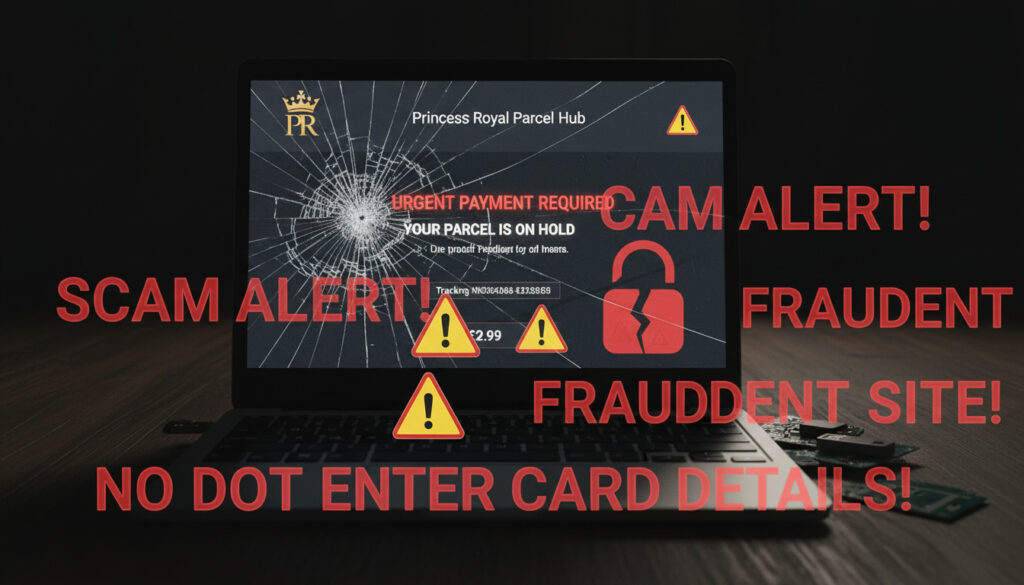
Princess Royal Parcel Hub – How to Spot and Avoid the Scam
Text messages claiming a parcel awaits collection at the Princess Royal Parcel Hub have reached thousands of UK mobile users since 2023. Despite the official-sounding name, no such facility exists within Royal Mail’s operational network, and security agencies confirm the communications are fraudulent phishing attempts designed to steal financial data.
The scam operates through SMS (smishing) and occasionally email, exploiting the high volume of genuine parcel traffic in Britain. Recipients are told they must pay a redelivery fee or confirm address details to release a package from this fictional sorting facility.
Understanding the mechanics of this fraud protects consumers from malware installation, identity theft, and unauthorized banking transactions. Authorities including the National Cyber Security Centre and Citizens Advice have issued specific guidance regarding these notifications.
Is Princess Royal Parcel Hub a Scam?
- Impersonates Royal Mail, the UK’s designated universal postal service provider
- Utilizes SMS phishing vectors claiming missed deliveries require immediate action
- Directs users to counterfeit domains such as royal-mail.cloud to harvest credentials
- Demands payment for fictional collection or redelivery fees ranging from £1.50 to £3.00
- Distributes Android-specific malware capable of intercepting banking authentication codes
- Holds no registration with Companies House or Royal Mail’s official depot directory
- Identified by Citizens Advice and Royal Mail as a known fraudulent entity
| Fact | Details | Source Type |
|---|---|---|
| Entity Status | Non-existent / Fraudulent | Fraud Registry |
| First Documented Reports | Early 2023 | Consumer Forums |
| Primary Attack Vector | SMS Phishing (Smishing) | Cybersecurity Analysis |
| Typical Malicious Domain | royal-mail.cloud (variants) | URLScan Databases |
| Risk Classification | High (Financial & Data Theft) | Banking Fraud Teams |
| Geographic Concentration | United Kingdom | Telecom Provider Data |
| Official Confirmation | Listed as scam example | Royal Mail Security |
What is Princess Royal Parcel Hub?
Princess Royal Parcel Hub represents a fabricated logistics facility invented by criminal actors to lend credibility to phishing campaigns. The name suggests a prestigious, high-volume sorting center, perhaps referencing the Princess Royal’s public profile to imply royal endorsement or government affiliation.
Investigations by consumer protection groups reveal no lease records, business registrations, or postal licenses associated with this entity. The hub exists solely within the text of fraudulent SMS messages and the temporary phishing websites linked from them.
How the Scam Operates
Victims receive unsolicited messages stating a delivery driver attempted to deliver a parcel but was unsuccessful. The text claims the item now resides at the Princess Royal Parcel Hub and requires immediate fee payment or address confirmation to prevent return to sender.
Links embedded in these messages route through URL shorteners to evade detection. Upon clicking, victims encounter sophisticated replicas of Royal Mail’s tracking interface. These pages prompt for personal information, payment card details, and occasionally request download of “delivery confirmation” applications that install malware.
The Technical Infrastructure
Domain generation algorithms create numerous website variants using slight misspellings of Royal Mail or plausible but fake subdomains. NCSC guidance confirms these sites often host JavaScript keyloggers and mobile banking trojans targeting Android devices specifically.
Messages referencing Princess Royal Parcel Hub contain links to active phishing sites. The National Cyber Security Centre confirms these SMS deliveries frequently carry malware payloads designed to compromise banking authentication codes and contact lists.
Where is Princess Royal Parcel Hub Located?
No physical address exists for this facility. Royal Mail operates 37 mail centers and numerous local delivery offices across the UK, none bearing this designation. Searches of Land Registry and commercial property databases yield no results for warehouses, industrial units, or offices operating under this name.
Absence from Official Records
Royal Mail’s public depot locator and internal facility directory contain no reference to a Princess Royal Parcel Hub. Companies House records show no limited company, partnership, or sole trader registration matching this trading name. The entity lacks VAT registration and any postal operator license from Ofcom.
Fabricated Location Claims
Some SMS variants suggest addresses in London, Birmingham, or Manchester to appear geographically plausible. These addresses correspond to either non-existent street numbers or unrelated commercial properties with no connection to postal operations. Parcel delivery scams frequently employ such geographic specificity to bypass skepticism.
What Should You Do If You Receive a Princess Royal Parcel Hub Notification?
Immediate deletion represents the safest response. Do not engage with the message, click embedded links, or reply to the sender, as confirmation of active numbers increases targeting frequency.
Immediate Protective Actions
Verify any genuine parcel concerns directly through the official Royal Mail website by manually typing the URL into your browser. Never use links from unsolicited texts. If expecting a delivery, use your original tracking reference from the retailer, not information provided in unexpected messages.
Always verify parcel status directly through royalmail.com or the official Royal Mail app. Legitimate services never request payment via unsolicited text links or demand fees for redelivery of standard parcels.
Reporting Channels
Forward suspicious SMS messages to 7726 (SPAM) to alert your mobile network. Email phishing reports to reportascam@royalmail.com with screenshots of the message. File comprehensive reports through Action Fraud if financial loss occurred.
If you submitted payment details, contact your bank immediately to freeze cards and dispute transactions. Change passwords for any accounts sharing those credentials. Monitor credit reports for unauthorized applications and consider SMS phishing protection measures for future defense.
How Has the Princess Royal Parcel Hub Scam Evolved?
-
: For more details on how this scam has evolved, you can visit Sam Knows real broadband speed.
Initial SMS reports surface on consumer forums describing fictional hub and £2.99 “redelivery fees.”
-
:
Complaints peak during post-holiday periods; Which? and consumer watchdogs issue specific warnings about the Princess Royal naming variant.
-
:
Campaigns continue with modified domain names and localized address claims; malware payloads become increasingly sophisticated.
What Is Known and Unknown About This Fraud?
| Established Information | Uncertain Details |
|---|---|
| Operation is definitively fraudulent | Specific criminal organization or individual perpetrators |
| Zero affiliation with Royal Mail Group | Total number of victims and financial losses |
| SMS is primary delivery mechanism | Geographic origin of attack infrastructure |
| Active targeting since 2023 | Whether compromised data feeds specific fraud networks |
| Malware distribution confirmed in some variants | Relationship to other named parcel scams (e.g., “International Parcel Hub”) |
Why Are Parcel Delivery Scams Increasing?
The exponential growth of e-commerce creates fertile ground for delivery-related deception. British consumers received over 2 billion parcels in 2024, normalizing the expectation of frequent delivery notifications. Scammers exploit this volume, knowing recipients may be anticipating multiple packages and therefore more likely to suspend skepticism.
Psychological tactics include urgency creation (“package returns tomorrow”) and authority exploitation (using official-sounding hub names). The National Crime Agency notes that smishing requires minimal technical infrastructure compared to email phishing, lowering barriers for criminal entry.
Seasonal peaks amplify effectiveness. January post-holiday periods and November shopping events see coordinated campaigns timing messages to coincide with genuine high-volume delivery periods, making fraudulent notifications indistinguishable from legitimate traffic without careful scrutiny.
What Do Authorities Say About These Notifications?
Legitimate companies, including Royal Mail, will never ask for payment or personal information via unsolicited text message links. Delete these messages immediately and report them.
— Royal Mail Fraud Prevention Guidance
Missed parcel SMS messages are a common form of phishing. These texts often contain links to websites that will ask for your personal information or install malware on your device.
— National Cyber Security Centre
Key Takeaways on Princess Royal Parcel Hub
The Princess Royal Parcel Hub constitutes a non-existent entity used as a lure in sophisticated SMS phishing operations targeting UK consumers. No legitimate postal facility operates under this name, and any communication referencing it requires immediate deletion and reporting to cybersecurity authorities. Verification through official Royal Mail channels remains the only reliable method for confirming genuine delivery status.
Frequently Asked Questions
Is there an official Princess Royal Parcel Hub website?
No legitimate website exists. Any domain claiming to represent this hub is fraudulent and potentially dangerous.
Is Princess Royal Parcel Hub connected to Royal Mail?
No. Royal Mail confirms they operate no facility by this name and do not use such terminology in any official communications.
What happens if I clicked the link in the SMS?
Disconnect from the internet immediately, run comprehensive antivirus scans, change all passwords, and monitor banking accounts for unauthorized transactions.
Can I recover money if I paid the requested fee?
Contact your bank’s fraud department immediately. They may reverse unauthorized transactions under the Payment Services Regulations or chargeback schemes.
How can I distinguish real Royal Mail messages from fakes?
Legitimate texts never request payment via links or ask for personal data. Use only the official Royal Mail tracking page entered manually into your browser.
Why do scammers use the name “Princess Royal”?
The name implies authority and prestige, potentially suggesting royal endorsement or government affiliation to lower victims’ defenses.
More related posts
 Word With Friend Cheat – Be t App , Solver and Ri k in 2025
 Cornwall Campsite Safety Concerns – Sandways Beach Closure Update
 Abby Kpop Demon Hunters – Fan Backstories and Fandom Explained
 Incontinence Pants for Women – Best 2025 Picks and Guide
 UK State Pension Increase Campaign – Triple Lock and 2025 Updates
 Smoke (TV Series) – Cast, Plot, Episodes & Where to Watch
 UK 2025 Pensioners TV License – Free Licence for Over 75s
 Leo Woodall Movies and TV Shows – Complete Filmography Guide
