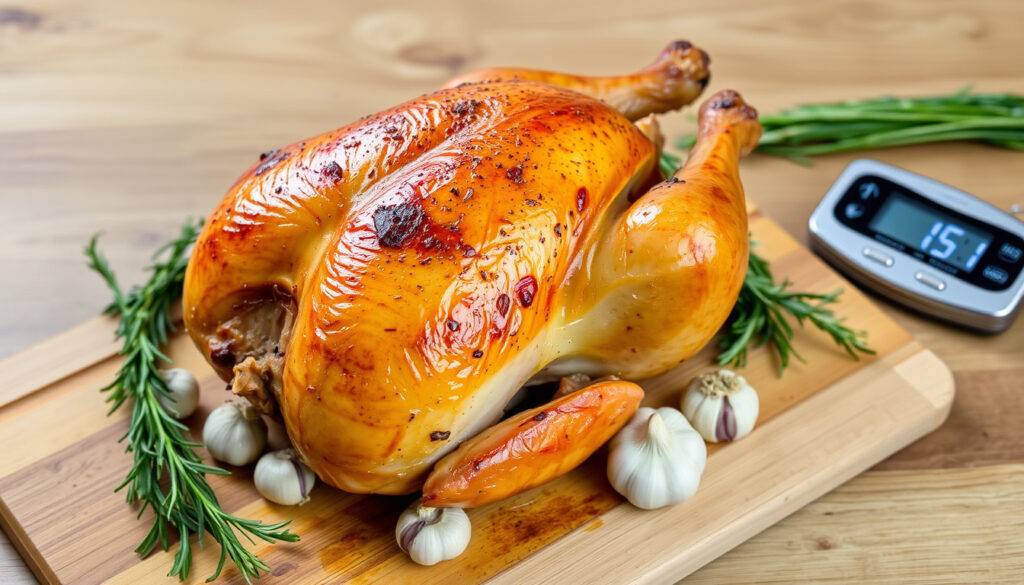
How to Roast a Chicken – Complete Guide With Time Per Kg
Roast chicken is a staple of home cooking, but the difference between a dry, uneven bird and one with tender meat and crisp, golden skin often comes down to two variables: oven temperature and cooking time per kilogram. While countless recipes exist, most are variations on a few simple heat principles.
The process is straightforward once the relationship between heat and weight is clear. Starting hot to sear the skin, then reducing the temperature to cook the meat gently, is the approach used by many established sources. Several formulas for timing exist, and understanding how they work helps achieve consistent results regardless of oven type or bird size.
This guide covers the key questions home cooks ask: what temperature to use, how long to cook per kilogram, which way up the chicken should go, how to get crispy skin, and how to tell when it is done.
What Temperature Should I Roast a Chicken At?
The most common approach among tested sources involves a two-temperature method. The chicken goes into a very hot oven first, around 220°C (450°F), for 10 to 15 minutes. This initial blast renders fat and starts browning the skin. After that, the temperature is lowered to around 180°C (350°F) for the remainder of the cooking time. RecipeTin Eats describes this as 10 minutes at 220°C then 20 minutes per 500g at 180°C until the internal temperature reaches 75°C (165°F).
Starting at a high temperature (220°C) gives crispy skin; then reducing to 180°C allows the meat to cook through evenly without drying out.
- Starting at a high temperature (220°C) gives crispy skin; then reduce to 180°C to cook through evenly.
- Trussing is optional but can help shape the bird; leaving legs free speeds cooking.
- Brining or salting the chicken 24 hours ahead dramatically improves moisture and flavor.
- Roasting breast-side down first reverses the heat gradient for juicier white meat.
- Basting during roasting helps with browning and adds flavor to the skin.
- Resting the chicken for 10–20 minutes after roasting allows juices to redistribute throughout the meat.
| Factor | Recommendation | Source |
|---|---|---|
| 1.5 kg chicken cooking time | ~1 hr 20 min at 190°C fan / 170°C conventional | BBC Good Food |
| 2 kg chicken cooking time | 10 min at 220°C then 1 hr 15 min at 180°C | RecipeTin Eats |
| General formula (method 1) | 10 min at 220°C then 20 min per 500g at 180°C | RecipeTin Eats |
| General formula (method 2) | 20 min per 450g + 20 min at 200°C / 180°C fan | Knorr |
| General formula (method 3) | 35 min per kg at 180°C | Sutton Hoo Chicken |
| Safe internal temperature | 75°C / 165°F in thickest part of thigh | USDA / multiple |
| Visual doneness cue | Juices run clear when thigh is pierced | Multiple sources |
| Resting time after roasting | 10–20 minutes under loose foil | Multiple sources |
| Crispy skin technique | Start at 220°C then reduce oven temperature | Multiple sources |
| Skin preparation | Dry skin in fridge uncovered before roasting | Sutton Hoo Chicken |
| Convection oven adjustment | Reduce set temperature by 20°C (25°F) | Multiple sources |
| Alternative pull temperature | 150–155°F if resting with carryover cooking | Cook’s Gazette |
How Long Does It Take to Roast a Chicken Per Kg?
Cooking time per kilogram is not a fixed number. It depends on oven temperature, whether the bird is stuffed, the accuracy of the oven thermostat, and the shape of the chicken. Three main formulas appear in widely used recipes.
The 20 minutes per 500g rule
RecipeTin Eats recommends 10 minutes at 220°C followed by 20 minutes for every 500g at 180°C. This works out to roughly 44 minutes per kg after the initial hot blast. A 1.5 kg chicken would take about 10 minutes plus 1 hour (three 20-minute intervals), totaling around 1 hour 10 minutes. A 2 kg chicken would take 10 minutes plus 1 hour 20 minutes, or about 1 hour 30 minutes total.
The 20 minutes per 450g plus 20 rule
Knorr uses a method of 20 minutes per 450g plus an extra 20 minutes at 200°C / 180°C fan. This equals roughly 53 minutes per kg when the extra time is included, but it does not scale perfectly linearly. For a 1.5 kg chicken, this produces a cooking time of about 1 hour 20 minutes.
The 35 minutes per kg approach
Sutton Hoo Chicken suggests a simpler calculation of 35 minutes per kg at 180°C. This yields shorter overall times: roughly 52 minutes for a 1.5 kg bird and 1 hour 10 minutes for a 2 kg bird. The source notes this as its preferred method for its specific birds.
Based on these sources, the practical range for cooking time per kg at moderate oven temperatures (180°C / 350°F) is 35 to 53 minutes per kg, with most recipes clustering around 40 to 45 minutes per kg after an initial high-heat sear.
Does cooking time change if the chicken is stuffed?
A stuffed chicken takes longer to cook because the cavity filling must also reach a safe temperature. The USDA recommends that stuffing reach 74°C (165°F). Cooking time may increase by 15 to 30 minutes for a stuffed bird, but using a thermometer is the most reliable way to confirm doneness.
Which Way Up Should I Roast a Chicken?
The orientation of the chicken in the oven affects how evenly the breast and thighs cook. Breast meat is leaner and cooks faster, while leg meat contains more connective tissue and benefits from slightly longer exposure to heat.
Breast side up
Roasting breast side up is the most common method. The breast is exposed to direct heat, which browns the skin nicely. However, because the breast sits above the thighs, it can dry out before the legs are fully cooked. Basting can help keep the breast moist, but this adds steps during cooking.
Breast side down
Some cooks reverse the orientation. Starting the chicken breast side down protects the white meat from direct heat while the legs cook more quickly. Near the end of roasting, the bird is turned breast side up to brown the skin. This technique can produce juicier breast meat but requires careful handling when flipping a hot bird.
Leaving legs free vs. trussing
Trussing the legs together with kitchen twine gives the chicken a neat shape but can slow cooking in the thigh area. Leaving the legs loose allows heat to reach the inner thigh more directly, potentially reducing cooking time slightly. Both approaches are valid; the choice depends on whether presentation or speed is the priority.
How to Get Crispy Skin on Roast Chicken?
Crispy skin is one of the most desired outcomes in roast chicken, and several techniques help achieve it. The underlying principle is that the skin must be dry and exposed to sufficient heat to render fat and become crisp rather than steam.
Putting a wet chicken into the oven prevents the skin from crisping. Moisture on the surface creates steam, which softens the skin rather than browning it. Patting the chicken dry and leaving it uncovered in the refrigerator for several hours or overnight is recommended by multiple sources.
Dry the skin thoroughly before roasting
Sutton Hoo Chicken specifically advises not to put the chicken in the oven wet and recommends letting the skin dry uncovered in the fridge before cooking. This step removes surface moisture and allows the skin to crisp more effectively.
Use butter or oil on the skin
Rubbing the skin with butter or oil helps conduct heat and encourages browning. The Family Dinner Project recommends butter for flavor and browning, while other sources use olive oil. Either works, as both fats promote Maillard browning.
Start hot, then lower the temperature
I’d Rather Be Meryl explains that starting at a high heat helps crisp the skin, then lowering the temperature finishes the cooking. Some sources also recommend returning the chicken to a higher heat near the end of roasting to re-crisp the skin.
Basting during roasting
Basting the chicken with pan juices once or twice during cooking can help with browning and add flavor. RecipeTin Eats bastes twice during the cook. However, basting too frequently or too early can introduce moisture that softens the skin, so it is best done in the later stages.
How Does the Step-by-Step Roasting Process Unfold?
- Preheat the oven to 220°C (425°F) – do this about 15 minutes before the chicken goes in.
- Prepare the chicken – pat it dry with paper towels, season inside and out with salt and pepper, and rub the skin with butter or oil. This takes about 5 minutes.
- Initial sear – roast at 220°C for 10–15 minutes to start browning the skin and rendering fat.
- Reduce temperature – lower the oven to 180°C (350°F) and continue roasting for the calculated time based on weight. For a 1.5 kg chicken, this is roughly 1 hour using most formulas.
- Check internal temperature – insert a thermometer into the thickest part of the thigh, avoiding bone. The target is 75°C (165°F). This check takes about 1–2 minutes.
- Rest the chicken – remove from the oven, tent loosely with foil, and let it rest for 10–20 minutes. This allows juices to redistribute throughout the meat.
- Carve and serve – carve after resting. The meat will be more tender and moist than if carved immediately. Learning how to carve a roast chicken properly helps preserve the texture of the meat.
What Internal Temperature Indicates a Cooked Chicken?
The most reliable way to confirm that a roast chicken is safely cooked is to measure the internal temperature with a probe thermometer. Visual cues can help, but they are less precise.
Established guidelines
Multiple sources agree that the safe internal temperature for chicken is 75°C (165°F), measured in the thickest part of the thigh or leg, avoiding contact with bone. The USDA sets this as the minimum safe temperature for all poultry. Knorr also targets 75°C / 165°F for its roast chicken recipe. If a thermometer is not available, piercing the thigh near the joint and checking that the juices run clear (not pink) is a secondary indicator used by most sources.
Variations in practice
Some variation exists in approach. Cook’s Gazette recommends pulling the chicken at 150°F to 155°F if it will be rested afterward, because carryover cooking raises the temperature an additional 5–10°F during resting. This technique requires experience and confidence in carryover heat. Additionally, cooking times can vary based on oven calibration, the specific shape of the chicken, and whether it is stuffed, none of which can be fully standardized in a written recipe.
| Established facts | Areas of variation |
|---|---|
| Chicken must reach at least 74°C (165°F) internal temperature to be safe. | Exact cooking time varies by oven calibration, chicken shape, and whether stuffed. |
| Roasting at too low a temperature can result in dry, undercooked skin. | Some chefs prefer a lower, longer roast (150°C) for ultra-tender meat, but skin may not crisp. |
| Resting is essential to allow juices to redistribute and the meat to finish cooking. | Air fryer roast chicken times are not yet standardized in major recipe databases. |
| Clear juices from the thigh indicate doneness when a thermometer is unavailable. | The exact resting temperature at which to pull the chicken varies by source. |
Why Does Roasting Technique Matter for Results?
Roast chicken is a classic home-cooked meal, but achieving consistent results requires understanding how heat transfers through the bird. The breast and thighs cook at different rates because of their different composition: breast meat is lean and cooks quickly, while leg meat has more connective tissue that takes longer to break down.
The science of crispy skin involves high heat to render fat rapidly. When the skin reaches a sufficient temperature, the fat melts and the proteins brown through the Maillard reaction. Brining or salting the chicken in advance ensures moisture retention inside the meat, which helps keep it juicy even as the skin crisps on the outside.
Modern convection ovens circulate hot air, which cooks food faster and more evenly than conventional ovens. When using a convection oven, reducing the set temperature by about 20°C (25°F) and checking for doneness earlier is common practice among experienced cooks.
What Do Trusted Sources Recommend for Roasting Chicken?
“A 1.5kg chicken will be perfectly roasted after 1 hr 20 mins at 190C/fan 170C/gas 5.”
— BBC Good Food
“The formula is: 10 minutes at 220C/450F, then 20 minutes for every 500g/1lb at 180C/350F until internal temp is 75C/165F.”
— RecipeTin Eats
“Roast for 20 minutes. Reduce the temperature to 180C/160C Fan/Gas 4 and roast for a further 1 hour…”
— BBC Food
What Is the Best Approach to Roasting a Chicken at Home?
Based on the available evidence from multiple established sources, the most reliable method for roasting a chicken at home involves preheating the oven to 220°C (450°F), patting the chicken completely dry, seasoning it inside and out with salt and pepper, rubbing the skin with butter or oil, roasting at high heat for 10–15 minutes, then reducing to 180°C (350°F) and cooking for roughly 40–45 minutes per kg until the thickest part of the thigh reaches 75°C (165°F). Resting the chicken under loose foil for 10–20 minutes before carving ensures the meat stays juicy. For those looking to use the pan drippings, best gravy recipes for roast chicken can complete the meal.
Frequently Asked Questions
Do I need to cover a chicken when roasting?
Typically no, leaving it uncovered promotes crispy skin. If the skin gets too dark before the meat is cooked, tent loosely with foil.
How to season a whole chicken for roasting?
Rub all over with softened butter, salt, pepper, and herbs like thyme or rosemary. Stuff the cavity with lemon halves and garlic cloves for extra flavor.
How long to rest a roast chicken after cooking?
Rest for 10–15 minutes under loose foil. Carve only after resting to allow juices to redistribute.
Can I roast a chicken in a convection oven?
Yes. Reduce the set temperature by about 20°C (25°F) and check for doneness earlier, as convection ovens cook faster.
What happens if I roast chicken at too low a temperature?
The skin may turn out rubbery rather than crisp. Low temperatures can also extend cooking time and dry out the breast meat before the thighs are fully cooked.
Do I need to bring the chicken to room temperature before roasting?
Most sources recommend roasting straight from the fridge. Letting it sit at room temperature for 30 minutes is common, but the effect on cooking time is minimal.
Should I wash the chicken before roasting?
Food safety authorities advise against washing raw chicken. Washing can spread bacteria around the kitchen. Patting dry with paper towels is sufficient.
How do I know if my oven runs hot or cold?
An oven thermometer placed inside gives an accurate reading. Many home ovens vary from the set temperature by 10–20°C, which affects cooking time.
Can I roast a frozen chicken?
It is not recommended. The outside will overcook before the inside thaws and reaches a safe temperature. Thaw completely in the refrigerator before roasting.
What is the best rack position for roasting chicken?
The middle rack allows even heat circulation around the bird. Placing it too high risks burning the skin, while too low may undercook the top.
More related posts
 Cirque du Soleil London – OVO Tickets Dates Royal Albert Hall
 Is a Cucumber a Fruit – The Botanical and Culinary Truth
 How to Lower Blood Pressure – Proven Natural Strategies
 Zach Braff – Biography, Net Worth, Movies and Age 2025
 Smoke (TV Series) – Cast, Plot, Episodes & Where to Watch
 Cost of Living Payment – Eligibility Amounts Dates Status
 Optimum Nutrition Whey Protein – Sizes, Nutrition and Buying Guide
 Conor Benn vs Eubank Jr 2 – Full Fight Results and Highlights
