Mount Everest – Height, Location, Deaths, and Key Facts
Mount Everest, known as Sagarmatha in Nepali and Chomolungma in Tibetan, rises to 8,848.86 meters (29,031.69 feet) on the border between Nepal and the Tibet Autonomous Region of China. It is the highest point on Earth and has drawn explorers, climbers, and scientists for more than a century. The mountain is part of the Mahalangur Himal sub-range of the Himalayas and sits at approximately 27°59′ N 86°56′ E.
First successfully summited on 29 May 1953 by Edmund Hillary and Tenzing Norgay, Everest has since seen thousands of attempts and hundreds of fatalities. Commercial expeditions that expanded in the 1990s increased both the number of climbers and the frequency of incidents. Today, the mountain remains a symbol of human endurance and a subject of ongoing scientific and ethical debate.
This article compiles verified facts about Everest’s height, location, climbing history, death toll, and the hundreds of bodies that remain on its slopes. All figures are drawn from official surveys, mountaineering databases, and peer-reviewed studies.
How Tall Is Mount Everest? (Height in Feet, Meters, Kilometers, and Miles)
- Mount Everest’s official height was revised in 2020 to 8,848.86 m (29,031.7 ft) after a joint Nepal-China survey, ending a long-standing discrepancy between the two countries.
- The mountain lies on the border of Nepal and Tibet (China), part of the Mahalangur Himal sub-range of the Himalayas.
- More than 300 climbers have died on Everest; the majority of bodies remain in place due to the difficulty and danger of recovery.
- Everest remains the ultimate mountaineering challenge, attracting hundreds of climbers each year despite significant risks.
- The death rate among climbers is about 1.5 percent, with a notably higher rate on the descent from the summit than on the ascent.
- Climbers over 60 face a much higher death rate than younger climbers, especially during the descent phase of the expedition.
| Attribute | Value |
|---|---|
| Elevation | 8,848.86 m (29,031.7 ft) – 2020 official |
| Location | Nepal-China border, Himalayas |
| Coordinates | 27°59′17″N 86°55′31″E |
| First ascent | 29 May 1953 – Hillary & Norgay |
| Most climbs (individual) | Kami Rita Sherpa – 29 summits |
| Total deaths (approx.) | ~340 (1922–2024) |
| Best climbing season | May (pre-monsoon) |
Where Is Mount Everest Located? (Country, Continent, and Coordinates)
Mount Everest sits on the crest of the Himalayan range, directly on the border between Nepal to the south and the Tibet Autonomous Region of China to the north. The summit is shared between the two nations under a bilateral agreement, and its precise coordinates are 27°59′17″N 86°55′31″E.
Which Country Is Mount Everest In?
Everest is not located within a single country. The summit ridge forms the boundary, so the mountain is jointly administered by Nepal and China. The southern side, including the popular Southeast Ridge route, lies in Nepal’s Sagarmatha National Park. The northern side is in Tibet, where the less frequently climbed Northeast Ridge route begins.
What Continent Is Mount Everest In?
The mountain is part of Asia, on the Indian subcontinent’s northern edge. It sits within the Himalayan range, which stretches across five countries: India, Nepal, Bhutan, China, and Pakistan. Everest is surrounded by other prominent peaks including Lhotse (8,516 m) and Nuptse (7,861 m).
The Himalayan range was formed by the collision of the Indian and Eurasian tectonic plates around 50 million years ago. That collision is still active, pushing Everest upward by roughly 4 mm each year. The mountain’s location in a seismically active zone also means it experiences frequent earthquakes, some of which have triggered deadly avalanches on its slopes.
How Many Bodies Are on Mount Everest? (Deaths and Remains)
A widely repeated estimate holds that about 200 bodies remain on Mount Everest. Many are located in the death zone above 8,000 meters, where the air is too thin to sustain life for long and where recovery operations are extraordinarily dangerous and costly. Bodies are often left in place because the terrain, altitude, ice, and weather make retrieval hazardous for rescue teams.
The total number of deaths since records began in 1922 is approximately 330 to 340, though different sources report varying figures depending on cutoff dates and counting rules. The long-term average is about 4.4 deaths per year, though more recent decades have seen averages of 5 to 6 deaths per year as the number of expeditions has grown. A study of climbers up to 2006 found an overall death rate of 1.5 percent, with a joint probability of summiting and surviving of 29.9 percent.
What Causes Most Deaths on Everest?
Common causes of death include acute mountain sickness, falls, avalanches, exhaustion, falling into crevasses, exposure, and hypothermia. Many fatalities occur during the descent rather than the ascent, a pattern linked to physical exhaustion and the effects of prolonged oxygen deprivation after reaching the summit. The deadliest single event on Everest occurred on 25 April 2015, when a 7.8-magnitude earthquake triggered an avalanche that killed 19 people at base camp. Another major tragedy took place on 14 April 2014, when an ice avalanche killed 16 Nepali climbing guides.
Above approximately 8,000 meters, the oxygen pressure is insufficient to support human life for extended periods. Climbers in the death zone face impaired judgment, muscle weakness, and a high risk of cerebral or pulmonary edema. Most of the bodies that remain unrecovered on Everest are located in this zone, where even short rescue operations are perilous.
What Is Mount Everest? (Overview and Key Facts)
Mount Everest is the tallest mountain on Earth, measured from sea level. It was named after Sir George Everest, the British Surveyor General of India, in the 19th century. The mountain is known locally as Sagarmatha in Nepal and Chomolungma in Tibet, both names carrying cultural and spiritual significance for the communities that live in its shadow.
How Was Everest’s Height Measured?
The first reliable measurement, made by the Great Trigonometrical Survey of India in 1856, calculated the height at 8,840 meters and designated it Peak XV. Discrepancies between Nepalese and Chinese surveys persisted for decades. In 2020, Nepal and China jointly declared an official height of 8,848.86 meters (29,031.69 feet), reconciling previous differences.
Who Has Climbed Everest?
The first successful summit was achieved by Edmund Hillary and Tenzing Norgay in 1953. The first solo ascent was made by Reinhold Messner in 1980, without supplemental oxygen. The first woman to summit was Junko Tabei of Japan in 1975. Since then, thousands of climbers have reached the summit, including record-holder Kami Rita Sherpa, who has summited 29 times.
You do not need to climb the mountain to experience it. The Everest Base Camp trek in Nepal is a two-week hike that reaches an elevation of 5,364 meters and offers close views of the peak. Several documentaries, including “Into Thin Air” and “Everest,” provide detailed accounts of the climbing experience and its risks without requiring physical effort.
What Is the Timeline of Major Events on Mount Everest?
- 1856 — Peak XV identified as the highest mountain on Earth; height estimated at 8,840 m.
- 1922 — First attempt to summit; first known deaths on Everest occur.
- 1953 — First successful ascent by Edmund Hillary and Tenzing Norgay on 29 May.
- 1996 — Disaster season with 12 deaths, later documented in Jon Krakauer’s book “Into Thin Air.”
- 2014 — Ice avalanche kills 16 Sherpa guides; the climbing season is canceled.
- 2020 — Official height revised to 8,848.86 m through a joint Nepal-China survey.
What Facts About Everest Are Certain and What Remains Unclear?
| Topic | Established information | Information that remains unclear |
|---|---|---|
| Height | The 2020 joint survey confirmed 8,848.86 m; previously disputed between 8,848 m (Nepal) and 8,844 m (China). | No remaining uncertainty — the current figure is accepted by both nations. |
| Number of bodies | Estimates range from 200 to over 300 bodies remaining on the mountain. | Many bodies are in unreachable locations and have not been officially counted; exact figures are not available. |
| Total deaths | Figures are updated annually; the Himalayan Database is the most reliable source. | Different sources report totals between about 322 and 340+, depending on cutoff dates and inclusion rules. |
| Location of summit | Summit coordinates are precisely surveyed; the border line is agreed upon by Nepal and China. | No significant uncertainty remains regarding the summit’s position. |
What Is the Broader Context of Mount Everest?
Geologically, Everest is part of the Himalayan orogeny, the ongoing collision between the Indian and Eurasian plates. The mountain continues to rise at roughly 4 mm per year, though this rate is offset by erosion and glacial retreat. The standard climbing route is the Southeast Ridge from Nepal, which passes through the Khumbu Icefall, the Western Cwm, and the South Col before reaching the summit. The Northeast Ridge from Tibet is the second most popular route.
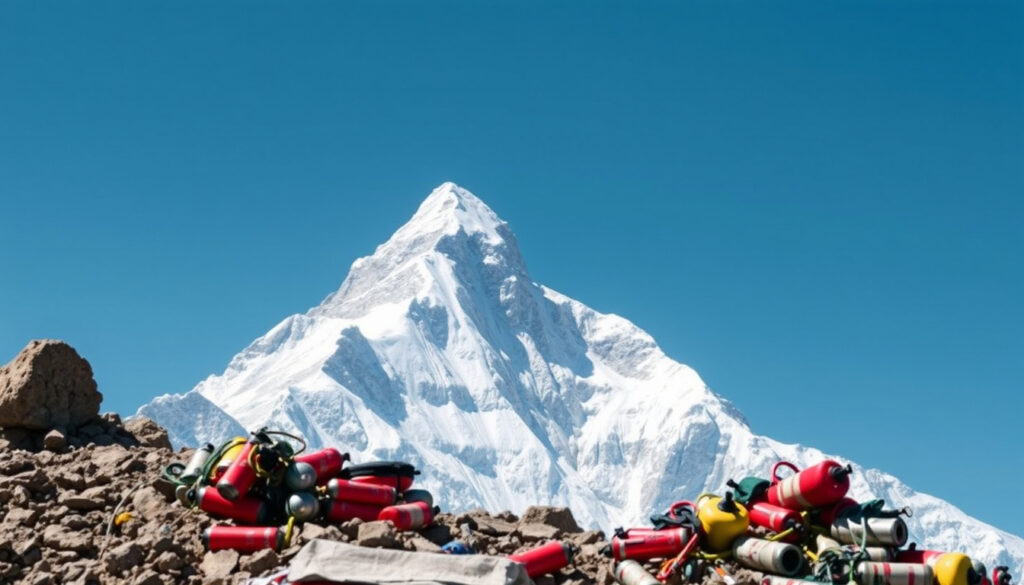
Climate change is altering Everest’s environment. Glacial melt has exposed more rock, increased the frequency of ice avalanches, and created new crevasses that pose risks to climbers. The mountain’s glaciers are retreating at accelerating rates, with significant implications for local water supplies and climbing safety. Garbage accumulation on the mountain has also become a growing environmental concern, prompting cleanup expeditions in recent years.
Culturally, Everest is known as Sagarmatha (Nepali) and Chomolungma (Tibetan), both names reflecting its sacred status among local communities. The mountain is central to the identity of the Sherpa people, who have guided expeditions for generations and whose contributions are often underrecognized in mainstream climbing narratives.
Where Can You Find Reliable Information About Mount Everest?
The most authoritative sources for Everest data include the Himalayan Database, which maintains official climbing statistics, and encyclopedic references such as Britannica and Wikipedia. The British Mountaineering Council (BMC) publishes verified facts and figures, while National Geographic provides educational content and expedition coverage. For peer-reviewed data on mortality and physiology, the PubMed Central database hosts studies such as the 2006 analysis of climber outcomes.
When consulting any source about Everest, it is useful to note that fatality totals, body counts, and annual death averages are frequently updated and may vary between publications. Differences in cutoff dates, counting rules, and seasonal updates mean that figures should be treated as approximations rather than fixed facts.
What Is the Future of Mount Everest?
Everest will continue to rise geologically, though the pace of change in its climbing environment is accelerating. Commercial expeditions are likely to grow further, bringing more climbers and pressure on safety and environmental regulations. Ongoing concerns about waste, overcrowding, and the ethical implications of commercial guiding are prompting new policies from Nepal and China. For those who will never climb it, Everest remains a source of fascination through documentaries, books, and virtual experiences that document the mountain’s enduring allure. For further reading, explore Mount Everest height and location and Everest climbing history and fatalities.
Frequently Asked Questions About Mount Everest
How much does it cost to climb Mount Everest?
Prices range from $35,000 to over $100,000 depending on the operator, permit, and support level.
How long does it take to climb Everest?
Typically 6–9 weeks including acclimatization and rotations.
Who was the first woman to climb Everest?
Junko Tabei from Japan, on 16 May 1975.
Is Mount Everest growing taller?
Yes, about 4 mm per year due to ongoing tectonic collision.
What is the most common cause of death on Everest?
Avalanches, falls, and altitude sickness (HACE/HAPE) are leading causes.
How many people summit Everest each year?
In recent years, roughly 800 to 1,000 climbers have reached the summit annually, though numbers vary with weather and permit restrictions.
Can you climb Everest without supplemental oxygen?
Yes, but fewer than 200 people have done so. The lack of oxygen above 8,000 meters makes it extremely dangerous and increases the risk of death.
What is the death zone on Everest?
It is the area above about 8,000 meters where atmospheric oxygen is insufficient to sustain human life for extended periods.
Are there age restrictions for climbing Everest?
Nepal requires climbers to be at least 16 years old. China sets a minimum age of 18 for the Tibetan side. There is no official upper age limit.
More related posts
 English to Arabic Translation – Free Tools, Apps and Tips for 2025
 Register A Company UK – 2025 Guide, Costs & Official Steps
 A2 Size in CM – Exact Dimensions and A Series Chart
 Toyota Hire Near Me – Find Local Jobs Today
 Kevin James Movies and TV Shows – Complete Filmography Guide 2025
 Bad Sisters Season 2 – Full Cast Episode Guide and Reviews
 America Ferrera Movies and TV Shows – Full List, Awards and Highlights
 You Season 3 Cast – Full Guide to Main and Supporting Actors
